Category 5Prep, Application and Downtime
What are the steps in a commercial metal roof coating job?
Metal coating jobs follow a set order, and the first step is always a close inspection of the existing roof.
- Inspect your roof by walking the panels, screws, laps and gutters and looking at the deck from inside the building.
- Repair holes, replace failed panels and swap stripped screws.
- Clean with a power washer and rust treatment.
- Prime rusted, galvanized or bare metal as the coating maker specifies.
- Seal laps with fabric or seam tape and cap every fastener.
- Apply the base coat across the field.
- Finish with the top coat once the base has cured.
- Walk the roof again at ridge caps, gutters, curbs and skylights.
Mil thickness gets checked during application so the coating meets the product's specification.
Can the building stay open while the roof is coated?
Most buildings stay open, because coating happens on the outside of the panels and the roof is never opened to the weather. Warehouses, shops and offices keep working underneath.
Planning covers a few items:
- Rooftop air intakes get closed or covered while solvent-based primers or coatings are in use nearby
- Loading docks under the work area get scheduled around lift moves
- Parked vehicles on the downwind side get moved on spray days
- Hatches and ladders stay clear for the crew and for building staff
A short meeting with the facility manager about shift times, deliveries and roof access sets the work order before the first day.
What happens to skylight panels, ridge caps and gutters?
Skylight panels, ridge caps and gutters each get their own detail, because they are the parts of a metal roof that leak first.
Translucent skylight panels are usually swapped for new ones or sealed at their edges, since coating over them blocks the daylight they exist to give. Their laps with the steel panels get fabric and sealer.
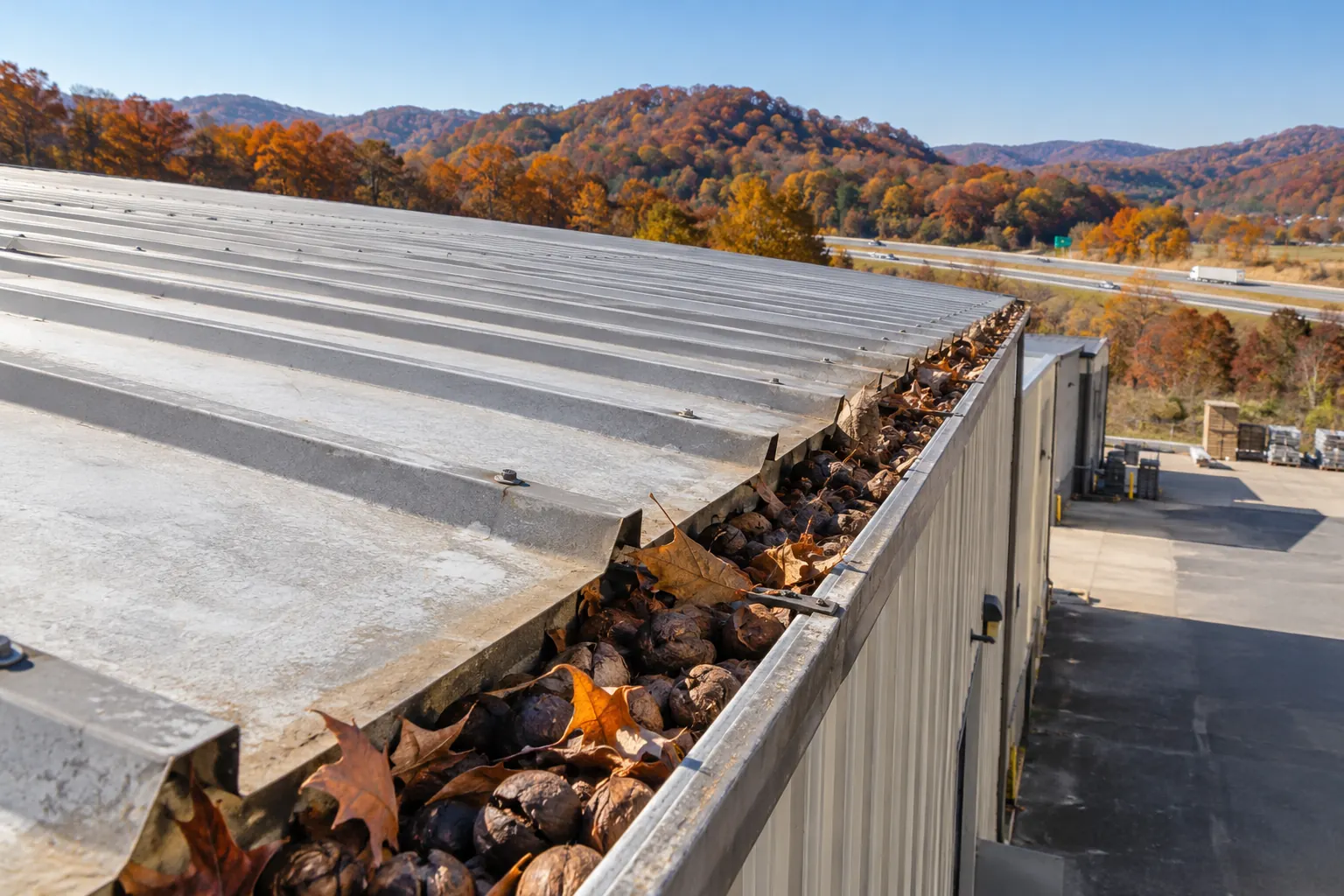
Ridge caps get their closures checked and their screws tightened, and the joints between caps get reinforced. Gutters are cleaned out, rust spots primed, and seams and end caps sealed with fabric and coating inside the trough. Downspout outlets are cleared so water leaves the roof fast.
Is a metal roof coating sprayed or rolled on?
Both methods work, and many jobs use both: spray for the open field and rollers or brushes for laps, screws and edges.
Spraying covers large panel runs quickly and gets into the corrugations of R-panel evenly. Rolling gives more control near parking lots, neighboring buildings and rooftop equipment, and on windy days.
Brushes handle the detail work, such as working sealant around screw heads, pipe flashings and curb corners. Whatever the method, the crew checks wet film thickness with a gauge as it goes, since panel ribs and valleys can leave thin spots if the coat is rushed.
Category 6Cost, Value and Taxes
What drives the cost of coating a metal roof?
Roof size, the amount of rust, and the number of screws and laps to seal are the biggest cost drivers on a metal coating job. A clean standing seam roof needs far less labor than a rusty screw-down roof.
Other factors that move the cost:
- Panel replacement where rust has eaten through
- Skylight panels to replace or reseal
- Coating type, primer needs and total dry film thickness
- Gutter and ridge cap repairs
- Access for lifts, hose runs and material staging
- Building height and roof pitch
- Spray foam, if insulation is part of the scope
A roof walk with photos and measurements sets the scope, and the scope sets the cost.
Does Section 179 apply to a metal roof coating project?
A roof on existing nonresidential real property can qualify as Section 179 property under IRS Publication 946, when placed in service after the building itself was first placed in service.
For tax years beginning in 2026, Publication 946 sets the maximum deduction at $2,560,000, reduced once qualifying property placed in service passes $4,090,000. Residential rental property falls outside the rule.
Whether a coating counts as a roof improvement or a repair expense is a tax question for your CPA, who can look at the scope, the condition of the panels before work, and your own return.
Can a white coating lower cooling costs in a Kentucky building?
White reflective coatings keep metal panels cooler in summer sun, which cuts heat moving into air-conditioned space underneath. The size of the change ties to how the building is cooled and insulated.
The DOE Guide to Cool Roofs describes the two ratings that matter: solar reflectance and thermal emittance. The Cool Roof Rating Council publishes a directory of rated roof products, including coatings, so owners can compare the numbers.
Gains are largest on cooled buildings with little insulation. An unheated storage barn sees less benefit, and in winter a reflective roof gives up a little solar warming, which the DOE guide also notes.
Category 7Permits, Codes and Utilities
Who handles commercial roof permits in Elizabethtown and nearby towns?
The local building official where the building sits is the first stop, and the Kentucky Department of Housing, Buildings and Construction posts county contact sheets naming local and state inspectors.
| Town | County | Local building inspection | Note |
|---|
| Elizabethtown | Hardin | City Planning and Development | City has expanded code jurisdiction |
|---|
| Cecilia | Hardin | Hardin County inspector | Census-designated place, no city government |
|---|
| Glendale | Hardin | Hardin County inspector | Unincorporated |
|---|
| Leitchfield | Grayson | Grayson County inspector | City's 2026 list shows no city inspector |
|---|
| Hodgenville | LaRue | LaRue County inspector | No separate city listing |
|---|
Confirm with the office before work starts, since staff and arrangements change.
Does coating a metal roof need a building permit?
Permit needs come from the local office, and they turn on scope. Replacing panels, repairing purlins, adding spray foam, or changing roof drainage is building work an inspector will want to know about.
A coating over existing panels with no structural change can be handled differently, so call before the crew mobilizes.
Have ready the building address, roof size, panel type, and a plain scope, such as "replace skylight panels, reseal screws and laps, apply silicone coating." Mention any rooftop unit that has to be lifted or disconnected to treat rust under its curb.
Which electric utilities serve commercial buildings in this area?
Several utilities split this region, so the name on the electric bill is the one to call. LG&E and KU run a Business Rebates page, and roofs are not named as a measure there, though insulation appears under custom projects.
Rural co-ops cover much of the countryside. Nolin RECC is based in Elizabethtown, and Meade County RECC and Farmers RECC also reach into Hardin County.
Ask the utility directly whether adding spray foam insulation over a metal roof fits any current business program. Program terms change, and no rebate is promised. The utility is also the call when a service mast or meter base sits on a roof being coated.
Category 8Questions by Town
Who reviews commercial roof work inside Elizabethtown city limits?
The City of Elizabethtown Planning and Development Department reviews plans and inspects most construction inside the city, under expanded jurisdiction from the state to enforce Kentucky's adopted building codes. Its staff includes a commercial building inspector.
Roof jobs touch two other offices. HVAC inspections inside the city are done by the state, which matters when a rooftop unit is lifted so rusted panels under its curb can be replaced.
Plumbing inspection runs through the Hardin County Health Department, which comes up if a gutter-to-storm connection or roof drain leader is changed. Calling the city first sorts out which of the three offices a given scope involves.
What roof problems show up on metal warehouses along I-65 in Elizabethtown?
Long exposed-fastener roofs on Elizabethtown's I-65 warehouses and plants tend to fail at end laps, screws and eave gutters first. Panel runs that long move a lot between hot afternoons and cold nights.
Common findings on these roofs:
- End laps opened by years of thermal movement
- Screws backed out along purlin lines
- Rust bloom at gutter seams and eave trim
- Cracked skylight panels in the field
Coating suits these buildings because the panels are usually still solid while the joints have failed. Fabric at every lap, new oversized screws where holes have wallowed, and a white top coat over the field address the pattern.
What makes Cecilia different for permits, given its address?
Cecilia is a census-designated place in Hardin County with no city government, so commercial roof work there falls to the Hardin County building inspector. The Cecilia mailing address on a bill or deed has no bearing on which office reviews the job.
The parcel's location is what counts. A building just southwest of Elizabethtown can sit inside city limits or in the county, so check the property record before calling.
When you reach the county office, give the parcel address and describe the work plainly, such as resealing an exposed-fastener shop roof or replacing rusted panels at the eave. Note any purlin or framing repair.
How does storm season affect metal roofs around Cecilia?
Severe storms crossing the open farmland around Cecilia, a former rail junction just southwest of Elizabethtown, hit its shops, farm buildings and church halls broadside, so loose ridge caps and lifted panel edges are the first things to check after a line of storms passes.
Warnings for Hardin County come from the National Weather Service in Louisville through its Ekron weather radio transmitter. Keep a weather radio in the shop office and plan a roof walk after any warned storm.
Look for screws pulled through panels at the eave, trim bent back at gable ends, and dents with cracked coating on the ridge. Wind-lifted edges get re-fastened before any sealing, since coating alone won't hold a loose panel down.
Who handles permits for a commercial roof in Glendale?
Glendale is unincorporated, so roof work there goes to the Hardin County local building inspector listed on the state's Hardin County contact sheet.
Many rural lots around Glendale hold older barns and sheds now used as shops, storage or small businesses. If the building's use has changed, such as a farm building turned into a retail or gathering space, mention that on the call, since a change of use raises its own code questions.
Describe the roof scope too, including any skylight panel replacement, new gutters or framing work, so the inspector knows what the crew will touch.
Can an older barn-style metal roof near Glendale be coated?
Older screw-down metal on wood purlins can be coated around Glendale once the wood is checked and loose panels are re-fastened into solid framing. Wood purlins that have rotted at the eaves hold screws poorly, so those get repaired first.
On these roofs, watch for nail-down panels where nails have backed out, rust lines along overlapping ribs, and old tar patches. Tar has to come off or be sealed with a compatible primer, since many coatings won't bond over it.
Utility service for rural Hardin County is split among Nolin RECC, Meade County RECC and Farmers RECC, so check the bill before any meter or mast work.
Who inspects commercial roofing in Leitchfield?
The Grayson County local building inspector covers Leitchfield, according to the state's Grayson County contact sheet and the city's own 2026 inspector list, neither of which shows a separate city building inspector.
Grayson County also has its own assigned state building inspector, a different person from the one covering Hardin and LaRue counties. That matters for owners with buildings in more than one county.
Before work on a Leitchfield shop, office or plant roof, call the county inspector and describe the scope, including any panel replacement, purlin repair, or spray foam over the metal.
Which utilities serve metal buildings around Leitchfield?
Grayson County is served by more than one rural electric co-op, so a Leitchfield-area address could be on Nolin RECC, Farmers RECC or Meade County RECC lines. All three list Grayson County in their territory.
The bill settles it. That utility is the one to ask about business efficiency programs, and the one to call if a service mast passes through a metal roof that is being coated.
Industrial buildings around Leitchfield often have uninsulated metal roofs with translucent skylight panels. When sweating panels and summer heat are the complaint, spray foam over the metal plus a coating is worth comparing with a coating alone.
Who handles building permits in Hodgenville?
LaRue County's local building inspector covers Hodgenville, based on the state's LaRue County contact sheet, which shows no separate city inspector. The same state building inspector assigned to Hardin County is listed for LaRue.
Call the county inspector with the building address and the work planned. Brick commercial buildings around Hodgenville's public square often have low-slope roofs hidden behind parapets, sometimes metal and sometimes older built-up roofing.
If the job involves rebuilding parapet coping, replacing internal gutters, or changing where roof water exits, describe that up front, since drainage changes are the details an inspector wants to see.
What should Hodgenville owners know about coating metal on farm-supply buildings?
Farm-supply stores, equipment shops and pole buildings around Hodgenville are strong coating candidates when their screw-down panels leak but the steel is still solid. Corrosion near fertilizer or livestock areas spreads faster and needs thorough rust treatment.
LaRue County's power map is mixed. Nolin RECC, Farmers RECC, Inter-County Energy and Salt River Electric all list LaRue County, so match the co-op to the bill before asking about programs.
On these buildings, check sliding door headers, lean-to tie-ins and ridge vents. Those joints between different panel runs leak first and get fabric reinforcement.
Category 9Getting Started
What should I gather before a roofer walks my metal roof?
Records and photos of the roof save time on the first visit. Pull together what you have:
- Age of the roof and dates of past repairs or coatings
- Building drawings or the roof's square footage
- Photos of drips at skylights, ceiling stains, or wet insulation
- Locations of rooftop units, exhaust fans and roof hatches
- Notes on when leaks happen, such as wind-driven rain or snowmelt
List the building's hours and how it is used too. A plant running three shifts has different scheduling needs than a church fellowship hall or a seasonal storage barn.
How does a metal roof coating project start?
Every project with Elizabethtown Metal Roof Coating starts with a roof walk and a look at the underside of the panels from inside the building.
On top, the crew checks screws, laps, ridge caps, gutters and skylight panels, and marks rust that needs treatment. Inside, they look for daylight at laps, rust on purlins and stains on insulation.
From those findings comes a scope: which panels need replacing, how many screws to swap, what primer the metal needs, and which coating fits the roof's slope and use. The owner sees photos and the work order before anything is cleaned or coated.